
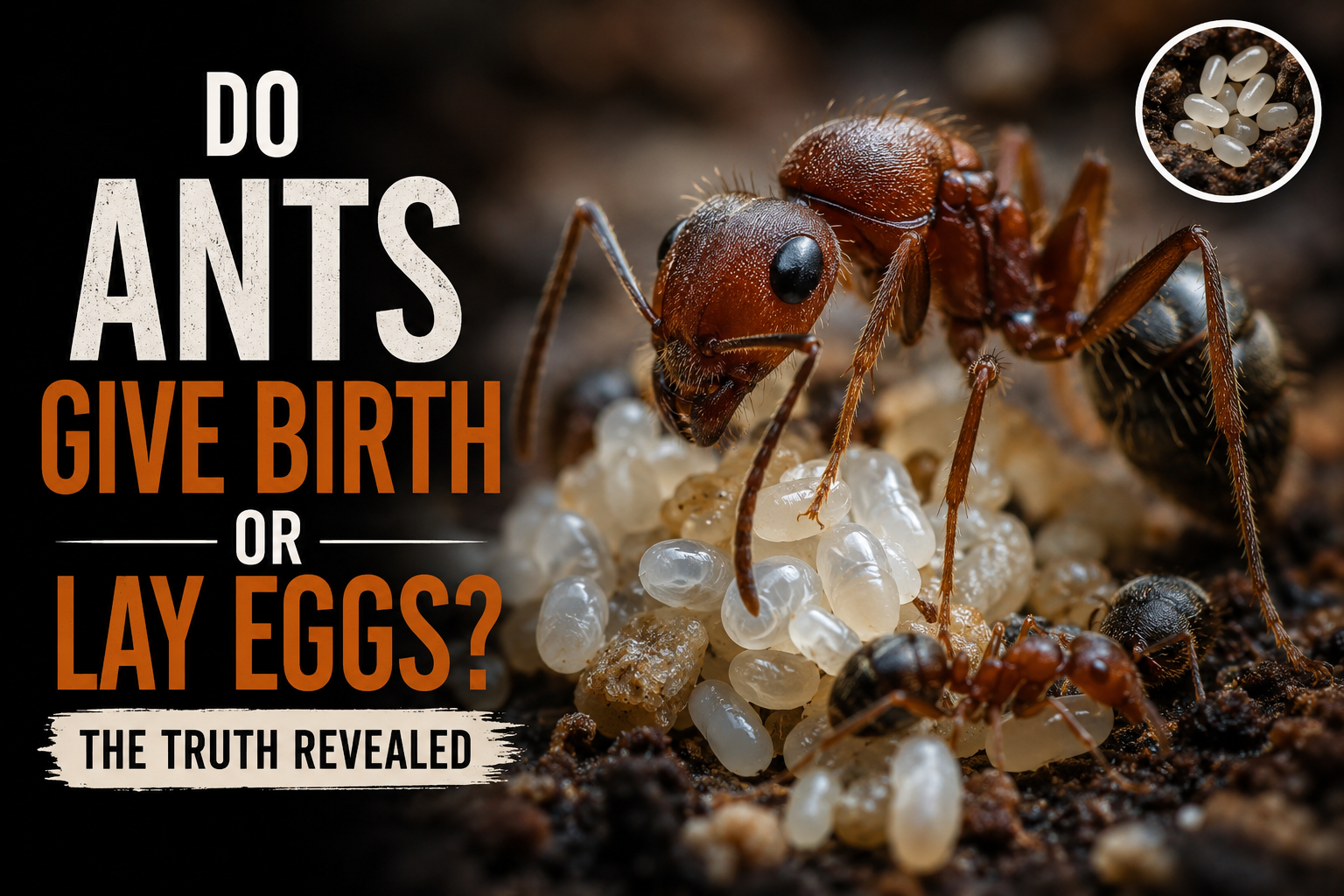
Ants are among the most successful insects on Earth, living in highly organized colonies that can contain thousands or even millions of individuals. Despite their small size, ants have a fascinating reproductive system that often raises an interesting question: Do ants give birth or lay eggs? The simple answer is that ants do not give birth to live young. Instead, ants reproduce by laying eggs, just like many other insects. Understanding ant reproduction helps explain how colonies survive, expand, and thrive in a wide variety of environments.
Do Ants Lay Eggs?
Yes, ants lay eggs. In fact, egg-laying is the foundation of every ant colony. The responsibility for producing offspring usually belongs to the queen ant. After mating, the queen stores sperm and uses it throughout her life to fertilize eggs. These eggs eventually develop into workers, soldiers, or future queens depending on the species and colony needs.
When people ask, “Do ants lay eggs?” they are often surprised to learn that only a small number of ants within a colony are capable of reproduction. Most ants seen gathering food or building tunnels are sterile worker ants that cannot reproduce.
Understanding Ant Reproduction
Ant reproduction begins during a special event known as the nuptial flight. During this period, winged male and female ants leave their colonies to mate. After mating, the male ant usually dies, while the fertilized female becomes a queen.
The queen then searches for a suitable location to establish a new colony. Once settled, she lays her first batch of eggs and cares for them until the first worker ants emerge. These workers take over tasks such as food collection, nest maintenance, and brood care, allowing the queen to focus entirely on reproduction.
This remarkable system has contributed to the success of ants for millions of years.
The Role of Queen Ant Eggs
The production of queen ant eggs is one of the most important functions in an ant colony. A healthy queen can lay hundreds or even thousands of eggs during her lifetime. Some species produce several queens within a colony, while others rely on a single queen.
The queen’s ability to continuously lay eggs ensures the survival and growth of the colony. Without a queen producing eggs, the colony would eventually decline as worker ants age and die.
Scientists studying queen ant reproduction have discovered that some queens can live for decades, making them among the longest-lived insects in the world.
The Ant Life Cycle
The ant life cycle consists of four distinct stages:
1. Egg
The cycle begins when the queen lays tiny white eggs. These eggs are often grouped together and carefully protected by worker ants.
2. Larva
After hatching, the eggs become larvae. Larvae resemble small, legless worms and rely completely on worker ants for food and care.
3. Pupa
As larvae mature, they enter the pupal stage. During this period, major physical changes occur as the ant develops its adult features.
4. Adult Ant
Finally, the pupa transforms into an adult ant. Depending on the colony’s needs, the new adult may become a worker, soldier, male, or future queen.
This complete transformation process is known as metamorphosis and is common in many forms of insect reproduction.
How Ants Reproduce
Many people wonder how ants reproduce so efficiently. The answer lies in the division of labor within the colony. The queen specializes in laying eggs, while workers perform all other essential tasks.
Once the queen begins laying eggs, worker ants maintain ideal conditions for development. They clean the eggs, move them to suitable temperatures, and protect them from threats. This teamwork dramatically increases survival rates and contributes to rapid colony expansion.
Ant Colony Growth
Successful ant colony growth depends largely on reproductive success. A colony starts small, often with a single queen and a handful of workers. Over time, continuous egg production allows the colony to increase in size.
As populations grow, colonies become more efficient at gathering resources, defending territory, and caring for young. Some ant colonies eventually contain millions of individuals and occupy vast underground networks.
The ability to sustain large populations is one of the reasons ants are found on nearly every continent.
Interesting Ant Eggs Facts
There are many fascinating ant eggs facts that people may not know:
- Ant eggs are usually white or cream-colored.
- Worker ants frequently move eggs to maintain proper temperature and humidity.
- Not all eggs become workers; some develop into queens or males.
- Certain species can determine offspring roles through nutrition.
- Queen ants can store sperm for years and continue producing fertilized eggs.
- Eggs are extremely vulnerable and require constant protection from workers.
These facts highlight the complexity of ant societies and their highly organized reproductive systems.
Ant Biology and Reproductive Success
The field of ant biology reveals how specialized ants have become over millions of years of evolution. Their reproductive systems, social structures, and division of labor work together to maximize colony survival.
Unlike solitary insects, ants function as a collective society where each member has a specific role. This cooperation allows colonies to adapt to environmental challenges and maintain stable populations.
Researchers continue to study ant biology to better understand social behavior, communication, and evolutionary success.
Ants and Insect Reproduction
Ants provide one of the best examples of insect reproduction in nature. Their reproductive strategies combine specialization, cooperation, and efficiency. While many insects reproduce individually, ants rely on a colony-based system where reproduction is concentrated in queens and supported by thousands of workers.
This unique approach has helped ants become one of the most abundant and successful insect groups on Earth.
Conclusion
So, do ants give birth or lay eggs? The answer is clear: ants lay eggs. Through a highly organized system of ant reproduction, queens produce eggs that develop through the ant life cycle from egg to larva, pupa, and adult. Queen ant eggs are essential for colony survival, while workers provide care and protection. Understanding how ants reproduce, the process of queen ant reproduction, and the factors behind ant colony growth offers valuable insight into one of nature’s most remarkable social insects. These incredible creatures continue to fascinate scientists and nature enthusiasts alike with their complex behavior, efficient organization, and extraordinary reproductive success.