
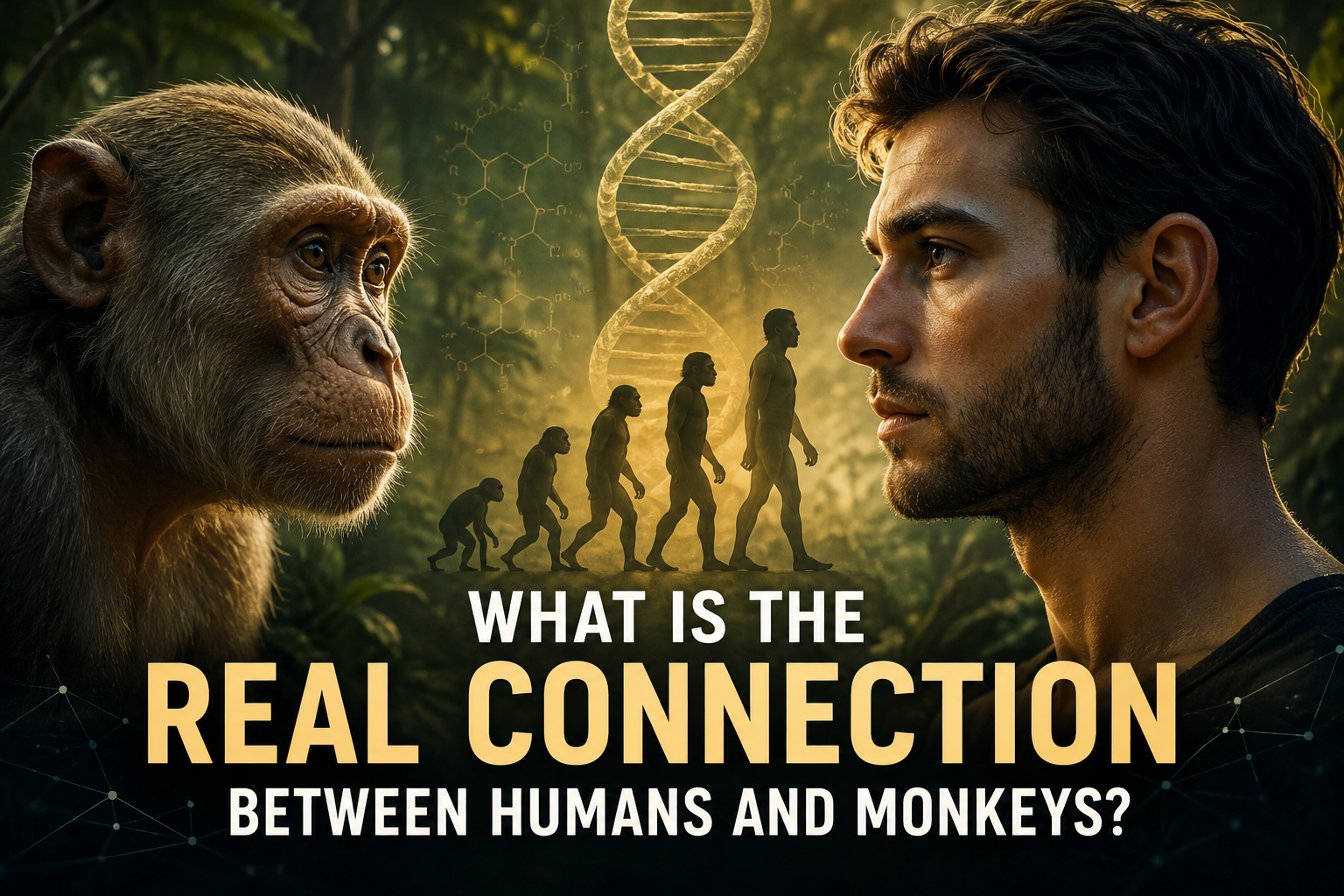
The relationship between humans and monkeys has been a topic of curiosity, debate, and scientific research for generations. Many people have heard the statement that humans came from monkeys, but the reality is more complex and fascinating. Modern science has revealed that humans and monkeys share a distant evolutionary connection, yet humans did not directly evolve from the monkeys we see today. Understanding this relationship helps us learn more about human origins, genetics, and the history of life on Earth.
What Is the Connection Between Humans and Monkeys?
Humans and monkeys belong to a large biological group known as primates. Primates include monkeys, apes, lemurs, and humans. Because they belong to the same group, they share many physical and genetic characteristics.
Scientists have discovered that humans and other primates share a common ancestor that lived millions of years ago. Over time, different populations evolved in different ways, eventually leading to the diverse species that exist today. This means that humans and monkeys are related through ancient ancestry rather than direct descent.
The Difference Between Monkeys and Apes
One of the most common misunderstandings involves the difference between monkeys and apes. Although they are both primates, they belong to different branches of the primate family tree.
Monkeys
Monkeys generally have tails, smaller brains, and different skeletal structures. Examples include:
- Capuchin monkeys
- Macaques
- Spider monkeys
- Baboon species
Apes
Apes do not have tails and are generally larger and more intelligent. Examples include:
- Chimpanzees
- Gorillas
- Orangutans
- Gibbons
Humans are more closely related to apes than to monkeys. In fact, chimpanzees are considered humanity’s closest living relatives.
Shared DNA Between Humans and Primates
One of the strongest pieces of evidence connecting humans and other primates comes from genetics.
Researchers have found that humans share:
- Approximately 98–99% of their DNA with chimpanzees
- Around 97–98% with gorillas
- Significant genetic similarities with many monkey species
DNA acts as a biological blueprint. The high level of shared DNA explains why humans and other primates have similar body structures, facial expressions, social behaviors, and even certain diseases.
However, even small genetic differences can create major changes in intelligence, language, physical appearance, and behavior.
Did Humans Evolve from Monkeys?
The short answer is no.
Humans did not evolve directly from modern monkeys. Instead, humans and monkeys share a common ancestor that lived millions of years ago. This ancestor was neither a human nor a modern monkey.
Imagine a tree with many branches. The trunk represents a common ancestor. Over time, the branches split into different directions. Some branches eventually led to modern monkeys, while others eventually led to apes and humans.
This branching process is known as evolution.
Evidence Supporting Human Evolution
Scientists rely on multiple forms of evidence when studying human origins.
Fossil Discoveries
Fossils provide clues about ancient species that lived long ago. Important fossil discoveries have revealed transitional species with both ape-like and human-like features.
Examples include:
- Australopithecus afarensis
- Homo habilis
- Homo erectus
- Neanderthals
These fossils help scientists understand how human characteristics gradually developed over millions of years.
Comparative Anatomy
Humans and primates share many anatomical similarities, including:
- Opposable thumbs
- Forward-facing eyes
- Similar bone structures
- Five-fingered hands
- Similar teeth patterns
These similarities suggest a shared evolutionary history.
Genetic Research
Modern DNA technology allows scientists to compare genomes between species. Genetic evidence consistently supports the idea that humans and other primates share ancient ancestors.
Why Are Monkeys Still Alive Today?
A question often asked is:
“If humans evolved from monkeys, why do monkeys still exist?”
The answer is simple: humans did not evolve from today’s monkeys.
Just as cousins can share grandparents while living separate lives, humans and monkeys share ancient ancestors while following different evolutionary paths.
Monkeys continued evolving into modern monkey species, while human ancestors followed a different path that eventually led to modern humans.
Human Intelligence and Unique Traits
Although humans share many similarities with primates, several characteristics make humans unique.
Advanced Language
Humans developed complex spoken and written language systems that allow detailed communication across generations.
Abstract Thinking
Humans can imagine future events, create art, develop scientific theories, and solve highly complex problems.
Technology
From stone tools to artificial intelligence, humans have developed technologies that dramatically transformed civilization.
Culture
Human societies pass knowledge, traditions, and beliefs from one generation to another through education and communication.
These traits helped humans become one of the most successful species on Earth.
Social Behavior in Humans and Monkeys
Interestingly, many social behaviors observed in humans can also be found in primates.
Scientists have documented:
- Cooperation
- Parenting behaviors
- Emotional bonds
- Problem-solving skills
- Group hierarchies
- Communication systems
Chimpanzees and some monkey species can even use simple tools, demonstrating impressive intelligence.
These similarities provide valuable insights into how social behavior evolved over time.
What Scientists Are Still Learning
The study of human origins continues to evolve. New fossil discoveries and genetic technologies regularly provide fresh insights into our past.
Researchers are currently investigating:
- Early human migration patterns
- Interactions between ancient human species
- Genetic adaptations
- The development of language
- The evolution of intelligence
Each discovery helps create a more detailed picture of humanity’s long history.
Conclusion
The human and monkey connection is one of the most fascinating topics in science. While humans did not directly evolve from modern monkeys, both groups share ancient ancestors that lived millions of years ago. Evidence from genetics, fossils, and anatomy strongly supports this relationship and helps scientists understand how humans became the species we are today.
By studying primates, researchers gain valuable insights into human evolution, behavior, intelligence, and biology. As scientific discoveries continue, our understanding of the human journey will become even more detailed, revealing new chapters in the remarkable story of life on Earth.