
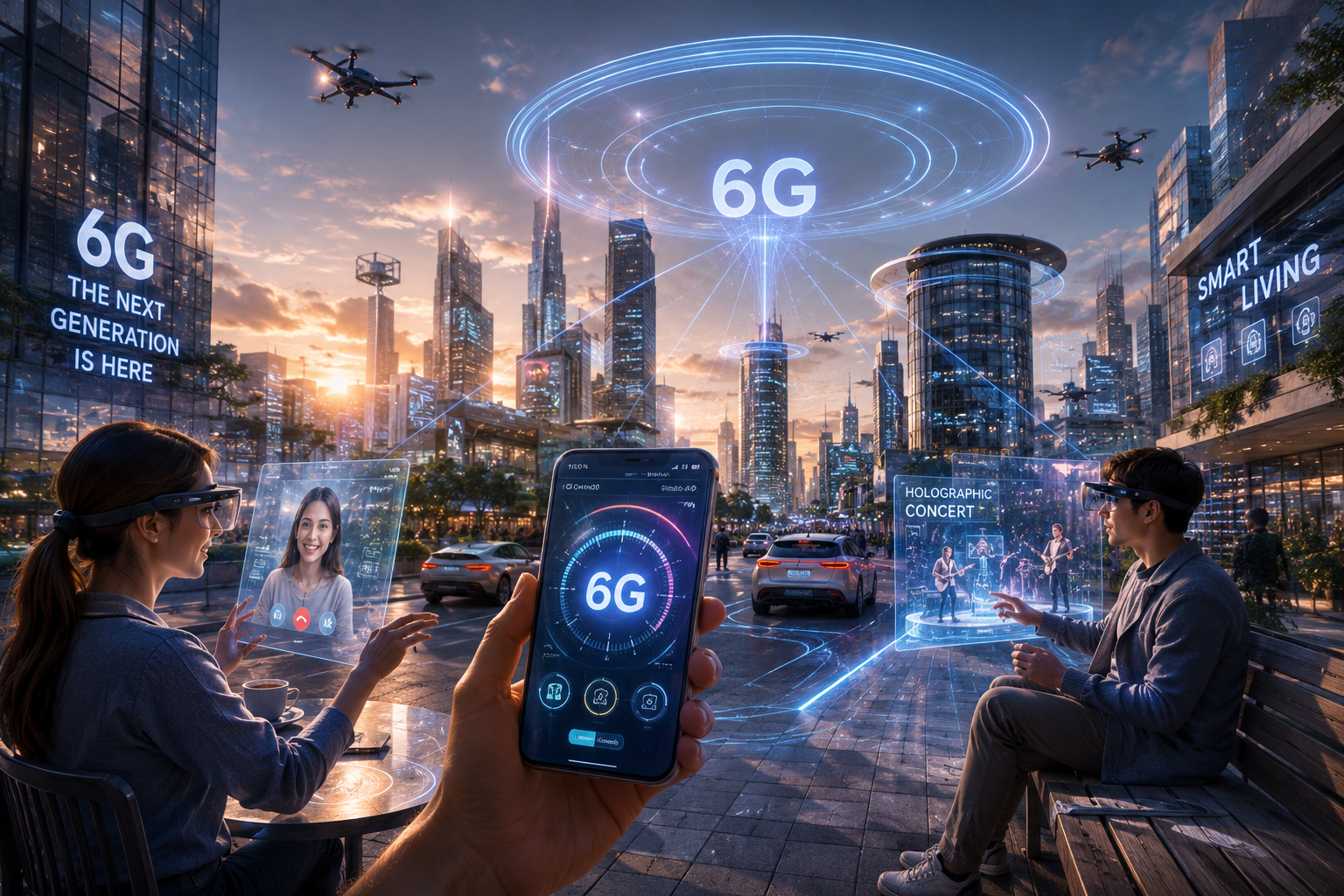
The world is still adapting to 5G technology, yet researchers, technology companies, and governments are already preparing for the next major leap in wireless communication: 6G technology. Expected to emerge commercially in the 2030s, 6G promises to revolutionize the way people connect, communicate, work, and interact with the digital world. With unprecedented speeds, near-instant response times, and powerful integration with artificial intelligence, 6G is poised to become the foundation of the future of internet connectivity.
As countries like China, the United States, South Korea, Japan, and members of the European Union invest billions in research and development, the race toward the 6G revolution has already begun. But what exactly is 6G, and how could it transform everyday life? Let’s explore the future of communication and discover why experts believe 6G could be one of the most important technological advancements of the century.
What Is 6G Technology?
6G technology refers to the sixth generation of wireless communication systems that will succeed today’s 5G networks. While 5G significantly improved speed, latency, and connectivity compared to 4G, 6G aims to push these capabilities to entirely new levels.
The primary goal of 6G networks is to create a seamless connection between the physical, digital, and biological worlds. Future devices, vehicles, machines, and even smart environments will communicate instantly through intelligent wireless systems powered by advanced artificial intelligence.
Experts predict that 6G will operate using higher-frequency spectrum bands, including terahertz frequencies, allowing vastly greater data transmission capacities than existing technologies.
The Incredible 6G Internet Speed
One of the most exciting aspects of 6G is its expected performance.
Current 5G networks can theoretically reach speeds of up to 10 gigabits per second. In contrast, researchers estimate that 6G internet speed could exceed 1 terabit per second under optimal conditions. This would make 6G approximately 100 times faster than 5G.
To put this into perspective:
- A full-length 4K movie could download in less than a second.
- Massive cloud-based applications would operate instantly.
- Virtual and augmented reality experiences would feel completely natural.
- Real-time holographic communication would become possible.
This level of performance represents a true leap toward an ultra-fast internet era where delays become virtually nonexistent.
Near-Zero Latency and Instant Communication
Speed alone does not define the future of wireless communication. Equally important is latency, the delay between sending and receiving information.
While 5G reduced latency to around one millisecond, future 6G systems aim to achieve response times measured in microseconds.
Such improvements could enable:
- Real-time remote surgery
- Autonomous transportation systems
- Industrial robotics
- Immersive virtual reality environments
- Instant cloud gaming experiences
Near-zero latency will transform the way humans interact with technology, creating experiences that feel truly instantaneous.
The Future of Internet Connectivity
The future of internet connectivity extends far beyond smartphones.
Today, billions of devices are connected through the Internet of Things (IoT). By the time 6G becomes mainstream, experts expect hundreds of billions of devices to communicate simultaneously.
Examples include:
- Smart homes
- Wearable devices
- Connected vehicles
- Industrial sensors
- Healthcare monitoring systems
- Agricultural technologies
Through advanced 6G connectivity, these devices will exchange information continuously, creating intelligent environments capable of making decisions automatically.
The internet will evolve from a network of connected devices into a network of connected intelligence.
AI and 6G: A Powerful Partnership
One of the defining characteristics of the next generation will be the integration of AI and 6G.
Unlike previous wireless generations, artificial intelligence will not simply run on top of the network. Instead, AI will become a core component of network operations.
Artificial intelligence will help:
- Optimize network performance
- Predict traffic patterns
- Improve cybersecurity
- Reduce energy consumption
- Manage billions of connected devices
This intelligent infrastructure will allow networks to adapt automatically to changing conditions and user demands.
The combination of AI and 6G could create communication systems that learn, evolve, and improve over time.
Smart Cities 6G: Building Intelligent Urban Environments
The development of smart cities 6G solutions could dramatically improve urban life.
Future cities may use millions of sensors and connected devices to monitor and manage essential services in real time.
Potential applications include:
Intelligent Transportation
Traffic lights could automatically adjust based on vehicle flow, reducing congestion and improving travel times.
Energy Efficiency
Smart grids could optimize electricity distribution while reducing waste and environmental impact.
Public Safety
Connected surveillance systems powered by AI could identify potential threats and coordinate emergency responses more effectively.
Environmental Monitoring
Sensors could continuously track air quality, water quality, and weather conditions to improve public health and sustainability.
The combination of smart cities 6G infrastructure and artificial intelligence could create safer, cleaner, and more efficient urban environments.
6G Applications That Could Change Everyday Life
The range of potential 6G applications extends across virtually every industry.
Healthcare
Doctors could perform remote procedures using robotic systems with almost no communication delay. Patients could wear health-monitoring devices that continuously transmit vital information to healthcare providers.
Education
Students may participate in immersive virtual classrooms featuring realistic holographic teachers and interactive simulations.
Entertainment
Future entertainment experiences could include holographic concerts, fully immersive virtual reality worlds, and real-time interactive content.
Manufacturing
Factories could rely on intelligent machines that communicate instantly, increasing efficiency and reducing downtime.
Agriculture
Farmers could use connected sensors, drones, and AI-powered analytics to maximize crop yields while minimizing resource consumption.
These transformative 6G applications demonstrate how the technology may touch nearly every aspect of modern life.
Holographic Communication Becomes Reality
For decades, science fiction has imagined people communicating through holograms.
With the bandwidth provided by 6G networks, holographic communication may become practical.
Instead of traditional video calls, users could interact with realistic three-dimensional representations of friends, family members, colleagues, and customers.
Business meetings, educational sessions, and social interactions could become significantly more immersive and engaging.
This represents one of the most exciting possibilities within the broader landscape of future communication technology.
Wireless Innovation and Extended Reality
Another area expected to benefit from wireless innovation is Extended Reality (XR), which combines virtual reality, augmented reality, and mixed reality technologies.
Current XR experiences often face limitations related to bandwidth, processing power, and latency.
6G could eliminate many of these barriers by enabling:
- Ultra-high-resolution displays
- Real-time rendering
- Instant cloud processing
- Seamless virtual interactions
As a result, virtual worlds may become nearly indistinguishable from reality.
Businesses, educators, healthcare professionals, and entertainment providers could all leverage these capabilities to create entirely new experiences.
Autonomous Vehicles and Transportation
Self-driving cars require constant communication with surrounding infrastructure, other vehicles, and cloud-based systems.
The enhanced reliability and speed of 6G connectivity could help autonomous transportation systems operate more safely and efficiently.
Future transportation networks may include:
- Self-driving cars
- Autonomous buses
- Delivery robots
- Smart traffic systems
- Connected public transportation
These systems could reduce accidents, lower emissions, and improve mobility for millions of people worldwide.
Cybersecurity in the 6G Era
As connectivity expands, cybersecurity becomes increasingly important.
Future 6G networks will need advanced security frameworks capable of protecting enormous volumes of sensitive data.
Artificial intelligence may play a critical role in identifying threats before they cause damage.
Potential security improvements include:
- AI-driven threat detection
- Advanced encryption technologies
- Quantum-resistant security systems
- Automated incident response
Building secure infrastructure will be essential for realizing the full potential of the internet of the future.
Environmental Benefits of 6G
Although advanced technologies often increase energy demands, researchers are working to ensure that 6G becomes more sustainable than previous generations.
Potential environmental benefits include:
- Improved energy efficiency
- Smart resource management
- Reduced transportation emissions
- Optimized industrial processes
- Better environmental monitoring
Through intelligent network management and AI-driven optimization, 6G technology may contribute to global sustainability goals.
Challenges Facing the 6G Revolution
Despite its enormous potential, several challenges remain.
Infrastructure Costs
Building global 6G infrastructure will require massive investments from governments and telecommunications companies.
Technical Complexity
Operating at higher frequencies presents significant engineering challenges related to signal propagation and coverage.
Privacy Concerns
As more devices become connected, protecting personal information will become increasingly important.
Standardization
International cooperation will be necessary to establish common technical standards and ensure compatibility across regions.
Overcoming these obstacles will be crucial for achieving the full promise of the 6G revolution.
When Will 6G Arrive?
Most experts expect commercial deployment of 6G to begin around 2030.
Research programs are already underway across major technology nations.
Leading organizations, universities, and telecommunications companies continue developing prototypes and testing emerging technologies that may form the foundation of future networks.
Although widespread adoption remains several years away, progress is accelerating rapidly.
Conclusion
The arrival of 6G technology could mark one of the most significant milestones in the history of digital communication. With extraordinary 6G internet speed, intelligent 6G connectivity, advanced integration of AI and 6G, and groundbreaking 6G applications, the next generation of wireless networks promises to transform industries, cities, and everyday experiences.
From immersive holographic communication and autonomous transportation to intelligent healthcare systems and sustainable smart cities 6G solutions, the possibilities are virtually limitless. While challenges remain, ongoing wireless innovation is bringing us closer to a future where the internet of the future becomes faster, smarter, and more connected than ever before.
The journey toward the future communication technology era has already begun, and the coming 6G revolution may reshape the world in ways we are only beginning to imagine.